Setting Expectations
Your certification paths, learning style & resources
Before we get into the material, let’s be explicit about what this block delivers and what it asks of you.
Two Destinations, One Body of Knowledge 🎯
Scrum.org certification. This block prepares you for PSM I, and — with the Product Owner Track in Section 08 — for PSPO I. Both exams test the Scrum Guide 2020 precisely, so every definition here uses its current wording, and we call out the places where older material (and many competing courses) still teach retired terms.
Adaptive & hybrid project delivery. The same content covers the adaptive portion of modern project management, including the PMP® exam, where adaptive and hybrid approaches account for the majority of the content. You’ll also learn to choose an approach — predictive, hybrid, or adaptive — which is a project professional’s judgement call, not a default.
OPEX Institute prepares you for these certifications; it is not affiliated with Scrum.org or PMI.
How we handle two vocabularies. Scrum.org and PMI describe much the same reality in slightly different words — PMI says servant leadership where the Scrum Guide 2020 says a true leader who serves; PMI speaks of iterative and incremental life cycles where Scrum speaks of Sprints. This block always teaches the Scrum wording as primary, then flags PMI’s term in a gold Lens note like this one. Follow both and you’ll answer correctly on either exam.
Your Learning Style: Practical and Immersive 💡
Learning adaptive delivery isn’t memorizing terms — it’s understanding how to apply them. This block uses an experiential model:
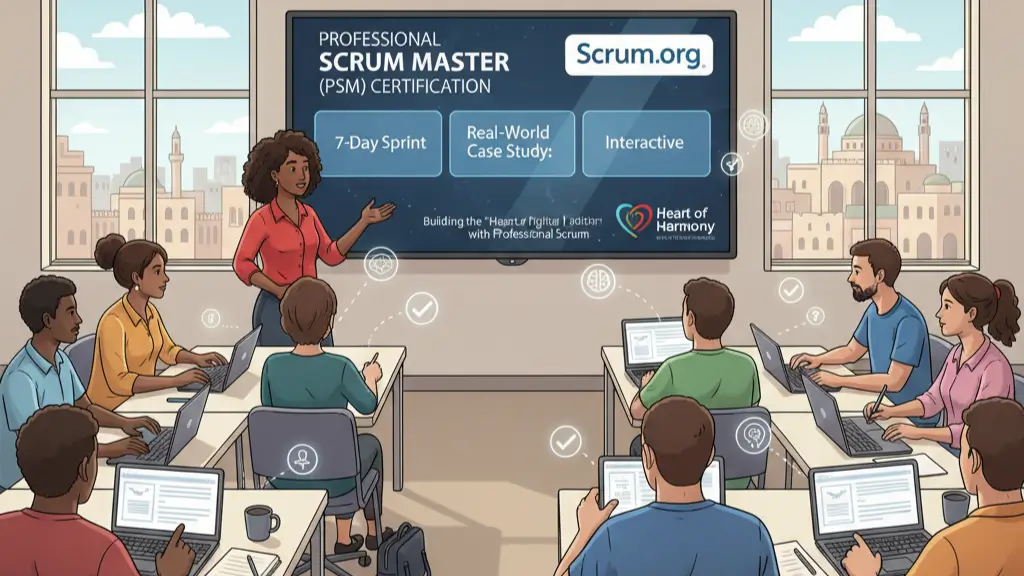
- 📂 Case study-driven — the ‘Heart of Harmony’ platform runs through every lesson, so you understand not only what the framework says, but how it behaves under real pressure.
- 🧠 Interactive & reflective — the “Why Not?” debriefs at the end of each section challenge the rules directly, which is how you build judgement rather than recall.
- 🎯 Exam-aware throughout — Exam Tips panels flag the specific traps and retired terminology that cost people marks.
- 🚀 Self-paced, incremental — focused sections that build on each other. Move at your own pace, but move in order: each section assumes the ones before it.
What We Expect From You ✅
- Engagement — actively relate each concept back to the case study, and to your own projects.
- Curiosity — pause, re-read, and interrogate the ‘why’. The debriefs exist for exactly that.
- Consistency — regular focused study, since the block builds progressively.
Ready to Begin?
We start where every adaptive practitioner should: with the map. Before learning one framework deeply, you need to know where it sits among the alternatives — and when it is, and isn’t, the right choice.